Just as public funding corrupts research universities, so too can funding from non-governmental sources when it represents a sizeable and non-anonymized portion of a given department’s funding. Funding from large businesses, wealthy individuals, or deep-pocketed foundations, if it accounts for a sufficiently large percent of the school’s or department’s activities, will procure the results these want. ‘Focused research’ will find what is paid for, and should those findings reflect the the truth that scientific and academic institutions claim to seek, it is purely accidental.
— Hadrien Laporte
Category: Writing
Words Mean Things: “Cultist”
cultist: n – In social media political discourse:
1) anyone who holds views different from yours with a degree of certainty equal to or greater than that with which you hold your own;
2) one who, having been informed of your disagreement with his obviously false views, stubbornly clings to them instead of immediately adopting your objectively true positions like any reasonable person would do;
3) someone who persists in obtaining information from sources you find questionable, even after you’ve made known your own disapproval of those sources;
4) a person who dares to question the authority of experts – especially those experts you know to be infallible;
5) an individual who, having considered the facts and arguments for himself, has anathematized himself by coming to independent conclusions different from the accepted consensus to which you sensibly adhere.
“Two Years Before the Mast”
There was an element of R.H. Dana’s Two Years Before the Mast that seemed very familiar to me: the feel of an isolated, even empty world that permeates Rime of the Ancient Mariner, Endurance, and Home of the Blizzard.
Sure, it’s clear at the beginning that there is in fact a bustling, settled civilization in the background (specifically 1830s Boston), but once Dana’s ship dropped “below the hill, below the kirk, below the lighthouse top”, as it were, it’s as if the outer world no longer exists, and he is sailing on the endless seas of an empty planet.
Even after arriving in California, this sense of emptiness is barely relieved by the presence of Mexicans, Indians, and the occasional crews of other ships. There are so few people, so sparsely settled, that if anything it makes the emptiness of the world seem more rather than less acute.
It struck me that this element is actually missing from the SF I have read.
Which is strange, as you’d think it’d be a pretty obvious detail to weave into the worldbuilding of (say) the first mission to Mars, or a newly-settled planet: the characters are alone, far from civilization and from help should it be needed. They wouldn’t have it in their head that someone is watching over them, because there isn’t anyone. They wouldn’t assume that someone can be summoned to rescue them at a moment’s notice, because there is no one to call. They would know they couldn’t simply “return to civilization” should they tire of their adventures, because they are what passes for civilization.
It’s not a sense of danger or threat, though. It simply is the way the world is around them. The conditioned sense of immersion in civilization wherever one goes is simply absent, because actual civilization itself is so distant as to be wholly absent.
I think the thorough rewrite of the former project’s “The Olympian Race” already captures some of this sense of isolation and emptiness in the climactic chapters, so this is timely.
One “character” detail that stood out for me was Dana’s personal reaction at his return to Boston. He’d dreamt for two years of finishing his contract and returning home, imagining what he would do and where he would go and who he would see. But when his ship at last reached the pier in Boston Harbor, he was instead overcome with a sense of inertia: “There is probably so much of excitement in prolonged expectation, that the quiet realizing of it produces a momentary stagnation of feeling as well as of effort. It was a good deal so with me.”
The account was fairly short, but no less powerful for that. And the book is peppered with such character observations of his crewmates and himself, fascinating little details that SF rarely seem to capture. In fairness, it’s easier to amass a collection of such observations to draw on when you spend two years immersed in the relevant environment, something rarely possible (even in analogue form) for SF writers.
I repeatedly had the same reaction I had while reading The Anabasis and Mawson’s account of his return to the hut in Home of the Blizzard: “This is such an amazing account – it would form the basis of a fantastic SF story.”
Alas, several SF versions of The Anabasis have been done. However, the story I’m currently working on, “Beneath a Silent Sky”, originated as an homage to Mawson’s account (albeit infused with paranoid mystery…).
One final item that struck me was the section written in 1860, documenting his observations from a return trip to California. In 24 years, everything that he had encountered had changed dramatically, in particular San Francisco Bay and the surrounding areas. In 1835, he described a smallish settlement around the Presidio, dwarfed by the main Mexican settlement at Monterey. When he returned, he found a city of 100,000-plus people, smaller but significant settlements scattered all around the bay, Alcatraz turned into a fortress, and a booming economy.
I always wondered if 15-20 years would be sufficient to settle Mars to the point that it could demand autonomy or sovereignty. Could enough settlers arrive and build a sufficiently large and diverse economy to support such a move? Well, here is one real-world example to draw on…
Matthias Adler on Utopias
What is a utopia but the humanly impossible, pursued by the philosophically reprehensible, using means morally indefensible?
– Matthias Adler
Busywork as Social Order Maintenance
I found this passage from Two Years Before the Mast interesting for several reasons (emphasis mine):
Before I end my explanations, it may be well to define a day’s work, and to correct a mistake prevalent among landsmen about a sailor’s life. Nothing is more common than to hear people say, “Are not sailors very idle at sea? What can they find to do?” This is a natural mistake, and, being frequently made, is one which every sailor feels interested in having corrected. In the first place, then, the discipline of the ship requires every man to be at work upon something when he is on deck, except at night and on Sundays. At all other times you will never see a man, on board a well-ordered vessel, standing idle on deck, sitting down, or leaning over the side. It is the officers’ duty to keep every one at work, even if there is nothing to be done but to scrape the rust from the chain cables. In no state prison are the convicts more regularly set to work, and more closely watched. No conversation is allowed among the crew at their duty, and though they frequently do talk when aloft, or when near one another, yet they stop when an officer is nigh.
…This is the usual resource upon a rainy day, for then it will not do to work upon rigging; and when it is pouring down in floods, instead of letting the sailors stand about in sheltered places, and talk, and keep themselves comfortable, they are separated to different parts of the ship and kept at work picking oakum. I have seen oakum stuff placed about in different parts of the ship, so that the sailors might not be idle in the snatches between the frequent squalls upon crossing the equator. Some officers have been so driven to find work for the crew in a ship ready for sea, that they have set them to pounding the anchors (often done) and scraping the chain cables.
In the full passage, Dana explains that there is more than enough necessary work aboard ship to keep the crew continually busy. But he implies here and elsewhere (and may at some point come out and say it explicitly) that the continuous employment at all times is a means of maintaining discipline and order among the crew. When every waking moment is taken up with some task (necessary or make-work), there is little opportunity or energy left for the kind of talk or actions that could lead to conflict or disobedience.
Which, when you think about it, is a lot like modern life: work, commuting, childrens’ enrichment activities, the DMV, tax prep, home maintenance, car maintenance, doctor or dentist appointments, walking the dog, bathing the cat, etc. And what time is not consumed in these tasks (some of which are the consequences of personal choices, and some of which seem consciously structured to maximize the waste of your time), omnipresent distractions like sportsball, addictive social media, banal entertainment, controversy-stoking “news”, shifting trends, etc. are there to absorb.
I can easily imagine this shipboard practice being implemented on ships traveling between Earth/Luna and Mars – and at least in the early days, in settlements themselves – for exactly the reasons thus far implied by Dana.
Matthias Adler on Causes
Yes, I’m sure all of this seems vitally important if not deadly serious to you today, but tomorrow, or the day after that, you’ll wake up to find all the other fish have shoaled abruptly in some entirely different direction. And you, terrified to be left behind, will just as abruptly drop today’s cause to follow along.
— Matthias Adler
Blog Name Change
Since I’m no longer writing in the Ares Project universe, I’ve (finally) changed the blog name, and will eventually migrate it fully over to fistfulofphotons.com.
The name comes from a URL I bought on a whim probably ten years ago, and then forgot I owned. I may change it again when I come up with a name I like for the new project, but this amuses me for now.
Better the Second Time Around
Creating an entirely new Mars-focused fictional universe has not been quite as difficult as I expected it to be.
I’d been toying with a few concepts for the past several months, and really started getting good ideas while on vacation – primarily about a “noodle incident” that creates the setting for the future history, a number of consequences in the fictional “present day”, and a few of the principal characters. So much came to me while hiking that I had to buy another notebook at Tesco to keep up.
I spent a few days after I got home working out a modified three-act structure that I think will make constructing the plots of the new novels a little easier. But rather than jumping right in to building the plots for a new trilogy, I got distracted by fleshing out the fictional infrastructure. The two play off of each other in interesting ways – I have three documents open at the moment, in which I’m capturing and integrating elements of the future history’s timeline, a large number of characters central to the trilogy (primary, secondary, and tag characters alike), and technological, social, historical, and other developments that happen between “now” (the point of departure) and then. It’s quite entertaining to see how each builds off of the others and suggests new ideas that might not have occurred to me had I tried building the plots first.
While I have a lot of pieces of plot, they haven’t snapped together yet. I can see it coming, though, and it’s got to be more efficient than putting a plot together and then doing the worldbuilding around it to make it work. The latter led to a lot of dead ends with the novel plots in the old project, requiring in some places some contrivances that would have stretched credulity.
In contrast, I hit on the idea of the “Dispatches” as a way to use and extend the worldbuilding that had been done already for the old project, letting the elements of the fictional universe suggest the stories. This worked very well, I think, as most of the Dispatches I outlined had plots with solid, organic endings from the outset.
The one thing that does chap my ass about this is all the things that I predicted in the old project’s future history that then materialized in the real world (browse the entries under the “Life Imitates Art” category for a small taste of these). Maybe I’m good at projecting trends and foreseeing innovations and their consequences – but maybe I’m not, and just got lucky the first time around.
As more comes together, I’ll start laying out here what that future history looks like, the key events and technological developments that shape the next forty years. I’ll also change the site name and update the layout once I decide what I want to call the new project.
Reading Analog, May/June 2024 Issue (Part II)
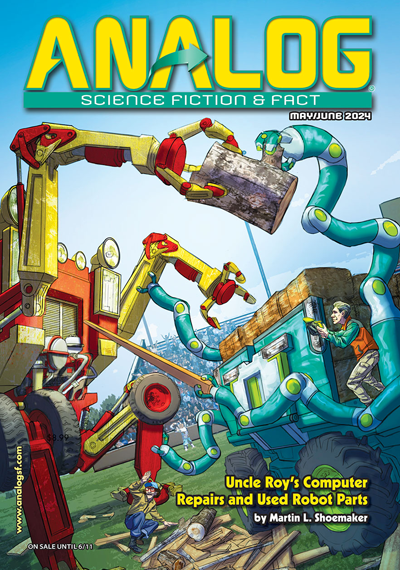
Continuing on from the earlier post:
Continue reading “Reading Analog, May/June 2024 Issue (Part II)”
Reading Analog, May/June 2024 Issue
Which would be this one:
So far, it’s reminded me very clearly why I cancelled my subscription in 2008 (and stopped actually reading the issues I received sometime around 2002).